U.S re-started fincial saction against North Korea

U.S. froze North Korean bank accounts since June
10 banks around the world, diplomatic sources familiar with the situation told the JoongAng Ilbo yesterday.


On Tuesday in Seoul, U.S. Secretary of State Hillary Clinton said the U.S. would levy additional sanctions on North Korea for the March sinking of the Cheonan.

“The U.S. Treasury Department and intelligence authorities began looking into about 200 bank accounts that showed suspicious activities involving North Korea,” an informed diplomatic source said. “Bank accounts used to deposit money earned from the North’s exports of arms, in violation of UN Security Council resolutions 1718 and 1874, were studied, along with accounts used to purchase luxury goods believed to be supplied to the North’s leadership.”

Of the 200 suspicious accounts, U.S. authorities narrowed their attention to about 100 and began freezing their assets, the source said. The accounts belong to about 10 banks in Southeast Asia, southern Europe and the Middle East, the sources said. All the accounts were opened and operated under aliases, the source said.

Resolution 1718 was adopted on Oct. 14, 2006, after the North’s nuclear test that month. The main sanctions were an arms embargo, inspection of cargo going in and out of the North, an export ban on luxury goods to the North and the freezing of assets of individuals and entities designated by the UN sanctions committee. Resolution 1874 was adopted in June 2009 after the second nuclear test in May 2009, and it reinforced the existing sanctions.

While the U.S. was public about freezing North Korean accounts at the Macao-based Banco Delta Asia in 2005, the latest freezings were done quietly, the source said.

“When the U.S. authorities informed the banks that there were problems associated with certain accounts, the banks quietly froze the assets, making it hard for the media to detect,” the source said. “The assets in those accounts are likely to be money Kim Jong-il needs to operate his regime, so this will deal a serious blow to the North.”

“The U.S. began the freezings before June,” the source said. “The moves should be interpreted as a part of new sanctions on the North to hold it responsible for the sinking of the Cheonan.”

The assets in those accounts were presumably raised through illicit trade of arms, counterfeiting money, money laundering and drug trafficking, the source said. “In the past, the North deposited money in African bank accounts created under aliases and raised through trafficking in elephant ivory, selling of counterfeit Viagra and exporting arms in Africa,” the source said.

The source said the new financial sanctions will be different from what happened in the Banco Delta Asia crisis that stalled the six-party nuclear talks for years due to the North’s protest. Instead of naming and shaming a specific bank as a money laundering institution and pressuring it to freeze North Korean assets, “quiet” moves are now preferred to avoid blowback from Pyongyang, the source said.

Another source confirmed the additional financial sanctions, noting that, “If the charges are very clear, then the Banco Delta Asia method will be used, while the silent method will be used in more ambiguous cases.”

Meanwhile, a senior U.S. official said a package of sanctions aimed at stopping Pyongyang’s illegal activities will be announced in the next couple of weeks. In a press briefing in Washington on Wednesday, Assistant Secretary of State Philip J. Crowley elaborated on the fresh sanctions announced by Clinton in Seoul.

“Much of what we’ve done up to this point has centered on proliferation activities that stem from specific authorities,” Crowley said. “We’re moving into strengthening our national steps to attack the illicit activities that help to fund the weapons programs that are of specific concern to us - things like the importation of luxury goods into North Korea, concerns that we have long had about trafficking in conventional arms. So there are authorities that we will strengthen nationally, and we’ll have more to say about that in the next couple of weeks.”

North Korea’s counterfeiting of banknotes and cigarettes, diplomats’ smuggling of cigarettes, banking transactions that fund weapons programs and support the government and its policies were named as some of the illegal activities to be tackled under the sanctions.

Crowley also said Robert Einhorn, special adviser for nonproliferation arms control, will soon begin a trip to encourage countries that have been reluctant to implement earlier sanctions, noting that the North has found ways to sidestep the measures.

“They look to see if there are seams and gaps in the international effort,” Crowley said. “That’s what Bob Einhorn is going to be consulting with a range of countries where we think there needs to be more aggressive implementation of Security Council resolutions 1718 and 1874.”

Crowley, however, refused to say what Einhorn’s destinations are and if they include China.

“China obviously has a big role to play in this,” Crowley only said.

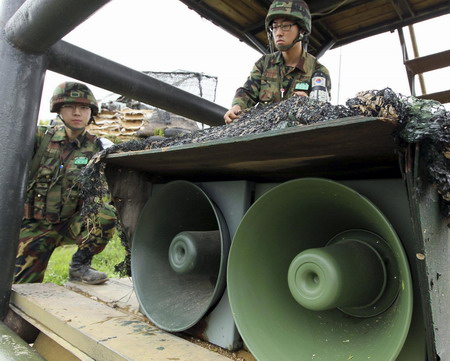
North Korea must be afraid of S.Korean Army's Resumption of Loudspeakers Broadcasting


In response to a barrage of statements made against North Korea the communist country threatened South Korea by saying that it will "aim and fire" their guns at loudspeakers placed near the border which the South used to broadcast anti-communist broadcasts.
The announcement made by the North Korean People's Army came right after South Korea's defense, foreign and unification ministers reached a conclusion at a joint conference to proceed with the psychological warfare operations which were halted for the past six years. Psychological operations refer to radio and loudspeaker broadcasts along the military Demarcation Line including the broadcasting of anti-North Korean propaganda.

Korea never forget Haiti's favor in Korean War


The catastrophe in Haiti is really lamenting. It is reporthed that the death toll from Haiti's devastating earthquake has topped 150,000 in the Port-au-Prince metropolitan area alone. The struggle for survival and rescue efforts is still going on.

They need more helping hands. Fortunately there are rush of relief supplies and troops from many countries. This time South Korea also decided to joins in efforts to help Haiti after quake. I am very happy because our country we can help Haiti. In old days we were the object of receiving aids from other country.

I remember that when I was young. I had eaten corn breads made by American supplies. Now we can help other country, especially the nation in plight. I heard that Korea is considering sending peacekeeping troops to Haiti. The number is about 200 troops. In addition, Korea is also planning $15 million aid to haiti.

As is known, in Korean war in 1950, Haiti aided Korea with lots of money worthy of about $8 miillion in present day. We naver forget our old boons. We will return the favor of every country which helped our country when we were in difficulties.

But this kind of relief efforts are not enough. This morning I watched a news scene on TV in which old week haitian men were dying because of lack of food and medical services. It made my heart ached. In this context, I have to thank for the U.S. and other countries helping Haitian refugees very actively.

Korea wins $40 billion nuclear deal


Korea won one of the world’s biggest nuclear energy contracts yesterday as the United Arab Emirates formally announced its decision to award the $40 billion deal to the consortium led by the state-run Korea Electric Power Corp.
The announcement came shortly after President Lee Myung-bak concluded a summit with the U.A.E. President Sheikh Khalifa bin Zayed Al Nahyan in Abu Dhabi. Lee flew to the Arab nation on Saturday to give one last push to win the contract. The deal is Korea’s first to export nuclear reactors that will be designed, built and operated with the nation’s indigenous technologies.
The $40 billion deal is worth about one-sixth of the Korean government’s 2010 budget. The former CEO of Hyundai Construction-turned-president with the nickname “Bulldozer” “had given specific advice from how to form a consortium to pricing strategies,” a presidential aide said. The Blue House said Lee focused on persuading Mohammed bin Zayed Al Nahyan, the crown prince of Abu Dhabi who had decisive power over the contract.
Lee promised the prince Korea’s preparedness to help the oil-rich country in the post-oil era, Blue House sources said. Shortly after his arrival in Abu Dhabi, Lee had a dinner with the crown prince, who came to the airport to greet him. “The crown prince’s welcome at the airport was a surprise, and President Lee promised that his meeting with the crown prince will serve as an opportunity to develop the two nations’ bonds,” Blue House spokeswoman Kim Eun-hye said.

Significance of Korea's Hosting of the G-20 Summit

G20 is a real Springboard For Korea to Jump Up to a Major Player of the Internatonal Community

Politically, the ROK'S hosting of the G-20 summit is a historic event which signify the paradigm shift from G-8 to G-20 as well as the emergence of the ROK as a main player of the international community from a mere peripheral country in Asia.


It also a great accomplishment attained by the President and the whole nation together signaling that the ROK, arising from its passive role, began taking part in forging new frames and plates of the international order.
with the hosting of the G20 summit, the ROK as a world leader will lead the rearrngement of the iternational order and truly join the league of advanced nations.


Economically, the ROK's hosting of the G-20 summit constitutes to an international acknowledement toward the President's efforts to take initiative in managing the world economy such as rejecting trade protectionism and calling for inernational in forging macro economic policies.

This is a reflection of the international community's trust toward the ROK for effectively taking policy measures in overcoming the economic crisis as well as high hope for the ROK to act a meadiator between advanced nations and developing ones.


In particular, this is a positive assessment of the international community of the President's global leadership in swiftly pulling the ROK economy out of the downturn and thus setting an excellant example of weathering economic crisis.


The launching of the G-20 regime indicates a shift in the existing economic system led by the G-8, and the ROK, in the process, will arise as a key player which can change the landscape of the world economy.

Such enhanced status of the ROK will not only ease the so-called Korea discount, but also contribute to expanding investment and export of Korea, thus creating the so called Korea Premium.

In term of the real economy, added values worth over 1 trillion Korean won are expected to be generated.

Kim Jong-il to the ICC!

Press conference participants hold aloft their slogans : they are shouting
"Kim Jong-il to ICC, Freedom to North Korean!"


The Investigative Commission on Crimes against Humanity was founded on Friday at the Press Center in Seoul.Recognizing the unacceptable scale of the atrocities committed by the North Korean regime, the commission vowed to “take specific steps towards prosecuting Kim Jong Il in the International Criminal Court” according to Doh Hee Yun, the commission’s administrator.


Its plan of action includes investigating the human rights abuses and other inhumane crimes of the regime, conducting scholarly seminars, creating a petition and simulating a court case against Kim in order to raise awareness of the issue, while in the mean time making preparations to prosecute Kim Jong Il in the ICC by December of this year.In its statement, the committee declared that placing Kim Jong Il in court would be a “historic event in pursuit of justice, peace and security on the Korean peninsula, giving freedom to the North Korean people” and further added that “our activities will be very effective in stopping the oppressive regime.”


The statement also pointed out, “We remember the unconditional aid that was given to the regime by the left leaning, pro-North Korea administrations of the past” and suggested that those who stand by the rhetoric of the North must be treated as complicit in its crimes.The co-chairs of the Commission are Kang Cheol Hwan (Committee for Democratization of North Korea), Lee Mee Il (Korean War Abductees’ Family Union), Han Chang Kwon (Association of North Korean Defector Organizations) and other four more representatives of NGOs based in Seoul.


The commission works in cooperation with around 50 North Korea related organizations including Network for North Korean Democracy, Free North Korea Radio, Korean War Abductees’ Family Union and the Database Center for North Korean Human Rights.

Proof of Korean ownership of Dokdo


There is overwhelming evidence that Dokdo was controlled by the Koreans before 1905. Here is a collection that refutes the official position of the Japanese government.
1. You can see Dokdo from Ulleungdo.
Dokdo and Ulleungdo (pronounced "ool-lung-daw") are visible from each other. Anyone living in Ulleungdo for long enough knows that Dokdo is out there. But Dokdo cannot be seen from any Japanese island at all.


Dokdo can be seen from Ulleungdo. (Source: Dokdo Center)


2. Koreans have inhabited Ulleungdo from prehistoric times.

Korean people lived in Ulleungdo since prehistoric times. Three Korean style dolmens (goindol) attributable to a period between about 300 B.C. to about 1 A.D. have been located in Ulleungdo. Dolmens are ancient tombs of the bronze age and the early iron age. The Korean peninsula contains about 40 % of all dolmens in the world. The majority of the rest of the dolmens are within Manchuria, which was within the territory of the ancient Korean kingdom of Gojoseon . The dolmens prove that Koreans lived in Ulleungdo at that time.
Photo above: An example of a Korean dolmen.
The rock carvings at Bangudae, Ulsan in Korea, shows images of whaling ships that accommodate about 20 sailors. If the ancient Koreans could sail to Ulleungdo to live there even if they cannot see Ulleungdo from the Korean mainland, surely they must have sailed to Dokdo that they could see from Ulleungdo.

Photo to the left:
Scholars believe that the rock carvings at Bangudae were made between the neolithic age and early iron age over a period of time.
3. Shilla, a Korean kingdom, conquered and annexed the local kingdom of Usan-guk in 512 A.D.
The first written reference to Dokdo appears in a Korean history book titled "Samguk Sagi"meaning "History of Three Kingdoms") which was compiled in 1145 A.D. According to Samguk Sagi, Isabu, a general of Shilla, conquered and annexed "Usan-guk," which refer to Ulleungdo and Dokdo collectively.
Picture to the left: The campaign of Isabu Kim in 512 A.D.

Photo above: A page of Samguk Sagi that describes the
conquest and annexation of "Usan-guk" by Shilla, a Korean kingdom.
4. Dokdo is included in Usan-guk.
Usan-guk includes the two islands of Mulleung and Usan, according to old Korean records such as "Sejong Shillok Jiriji," a publication in 1454 A.D. According to this record, the two islands are separated far enough so that they can be seen from each other only on a clear day. Only the pair of Ulleungdo and Dokdo satisfies this condition in the East Sea.

Another record, Goryeosa (高麗史; "History of Goryeo") Jiriji (geography section), which was published in 1451, provides a similar description asSejoing Shillok Jiriji of 1454.


5. An official expedition from a Korean government has been to Dokdo in 1476.

Annals of King Seongjong report an expedition to Dokdo in 1476. In this record, Dokdo is referred to as Sambongdo.

Reconstruction of the estimated route of the party of Ja-Ju Kim in their voyage to and from Sambongdo in 1476.


Peninsula Map on Dokdo : the island itself illustrates Korean territory ^^

6. Old Korean history books prove that Usan is Dokdo

Some Korean history books provide an explicit description of ownership of Dokdo. A 1756 History book titled "Border History" (疆界考) by Gyeong-Jun Shin describes historical borders of the Korean territory. A pertinent section states:
"In my considered opinion, the statement in Yeojiji (輿地志; note: Presently, no extant copy of this book is available) is correct, which states that 'although some dumb people theorize that Ulleungdo and Usan are one island, consideration of many maps leads to the conclusion that there are two distinct islands. One is what the Japanese refer to as Songdo (松島; Matsushima in Japanese). These two islands belong to Usan-guk (于山國).'"
Other Korean history books that also show Korean ownership of Dokdo include: Mangi Yoram ( 萬機要覽) of 1808, History of the East (海東繹史) of 1823, and Revised Encyclopedia of Records (增補文獻備考) of 1907.

The Ahn Yong-bok incident of 1696 demonstrates the exercise of exclusive dominion over Dokdo by the Koreans. Yong-bok Ahn was a local man of Ulleungdo that exercised the property rights of Korea against the Japanese fishermen in 1693 and 1696, pretty much the same way that a homeowner expels an intruder from his home. Subsequently, inspectors were dispatched every three years by the Korean government to Ulleungdo and Gajido (Dokdo) after Yong-bok Ahn's action to ensure that no Japanese activity was carried out there according to the Annals of King Jeongjo (1776-1800). Once again, two islands are mentioned.

Photo to the left: a page from Mangi Yoram on the Ahn Yong-bok incident: "Yong-bok followed them to Songdo and scolded them again. "Songdo is Usando. Have you not heard that Usando is our land?" And he used a big stick to destroy their large cooking pot. The Japanese were scared and ran away. Yong-bok went to Baekgi-Ju (伯耆州, referring to Shimane Prefecture) and told the story (to the government officials of that place). The governor punished them (the Japanese sailors)."

Photo to the left: A Japanese document, generated by a local official of Oki island in Japan in 1696 immediately after the Ahn Yong-bok incident, reads "8 Provinces of Chosun: Gyeonggi Province, Gangweon Province - within this Province exists Takeshima and Matsushima, Jeonla Province, Chungcheong Province, ...."

Photo to the left: After the Ahn yong-bok incident, Tokugawa shogunate (the Japanese government) sent a letter to the government of Chosun (Korea) in 1697 to notify that they had placed a ban on travel to Ulleungdo. While Dokdo is not mentioned in this document, inclusion of Dokdo in the ban was understood because Dokdo "belonged to" Ulleungdo. The actions of the Japanese government during the subsequent enforcement of the ban demonstrate that Dokdo was also included in the ban.

Due to the sheer number of available Korean maps that identify Dokdo as Korean territory, only two examples are provided here.
8.1 Carte de la Corée of 1846 by Dae-Geun Kim


Photos to the left: "Carte de la Corée," a map of Korea completed in 1846 by Dae-Geun Kim, made its way to Europe, and became the prototype map of many subsequent European maps. The original map was written in French, in which Ulleungdo was listed as "Oulangto" and Dokdo was listed as "Ousan," a French transliteration of Usan (우산, 芋山).


8.2 Daedong Yeojido of 1861 by Jeong-ho Kim

Photo to the left: A copy of a high resolution map of Korea, the Daedong Yeojido, (대동여지도, 大東輿地圖), published in 1861 by Jeong-ho Kim (김정호) and recently discovered in the Library of Japanese Parliament in 1997, schematically shows Dokdo.


9. In 1836, the Japanese government declares that Dokdo is a forbidden foreign territory.

Since the Ahn Yong-bok incident, the Japanese government placed a ban on seafaring into foreign countries. Later on, a young venturous Japanese man named Aizuya Hachiemon (會津屋八右衛門 or 会津屋八右衛門; あいずやはちえもん, 1798 - 1836) was captured, tried, and executed by the Japanese government for illegally operating a cargo vessel to Ulleungdo. At the trial of Aizuya Hachiemon, the Japanese government made it clear that Dokdo, as well as Ulleungdo, is included in the ban on seafaring.


Other proofs: Text of an edict from the Shogunate after the Aizuya Hachiemon case and
Aizuya Hachiemon's map that accompanied the Shogunate edict.
To ensure that everyone understood the ban on travel to Ulleungdo OR Dokdo, Matsudaira Hamada (松平浜田), who was the ruler of Shimane prefecture, issued a 4-page document titled "Ohesoozebonzangu (御解書御諸本帳; オヘソオゼボンザング) in 1838. All villages leaders had to read this document and put their signature on the last page of the document in acknowledgment.
First page of the public notice banning entry to Ulleungdo and Dokdo that was issued pursuant to disposition of Aizuya Hachiemon case.